
DIGICHer Project
- Home
- Synergies
- DIGICHer

REEVALUATE & DIGICHer synergy
DIGICHer and REEVALUATE are sister projects funded under the same Horizon Europe topic, and their connection goes back to the early stages of REEVALUATE’s ecosystem-building work.
Both projects are concerned with how cultural heritage moves into digital form, but they place emphasis on different parts of that process.
REEVALUATE works across prioritization, digitization, contextualization, rights management, validation and creative reuse.
DIGICHer looks particularly closely at who participates in digitization, whose perspectives are represented, how minority heritage is contextualized, and how institutions can make digitization processes more equitable and culturally sensitive.
This creates a natural area of exchange around:
- inclusive prioritization
- community participation
- contextualization
- representation and authenticity
- responsible access and reuse
- rights and governance
- long-term stewardship of digital cultural heritage
About DIGICHer
DIGICHer – Digitization of cultural heritage of minority communities for equity and renewed engagement – is a Horizon Europe project focused on making cultural heritage digitization more equitable, inclusive and sensitive to the rights and perspectives of minority communities.
The project examines the legal, policy, socio-economic and technological factors that shape the digitization of minority cultural heritage and is developing a practical framework to help cultural heritage institutions embed equity, diversity and inclusion throughout the digitization process.
Its work is being developed together with representatives of three minority communities in Europe: the Sámi, Jewish and Ladin communities. DIGICHer uses co-creation, citizen-science and user-centred approaches to ensure that communities themselves influence how their heritage is represented, contextualized, accessed and reused.
The project runs from February 2024 to January 2027.
Synergy at a glance
Main focus
Inclusive and community-centred cultural heritage digitization
Exchange areas
Participation, contextualization, representation, rights, access, reuse and policy
Collaboration type
Sister-project coordination, knowledge exchange, joint dissemination and policy collaboration
Synergy activities
Early sister-project meetings, technical and communication exchange, Europeana presentation, joint position paper and joint policy-event planning
Sister projects from the beginning
DIGICHer and IMPULSE were identified as REEVALUATE’s two most immediate sister-project relationships from the beginning.
By the first phase of the project, the three projects had already completed several common activities:
- online sister-project meeting
- a technical exchange
- a dissemination and communication planning meeting
- and a common presentation during Heritage Horizons/Europeana Project Week.
These exchanges established the basis for regular communication, knowledge sharing, joint dissemination and possible co-development between the three projects.
The sister-project connection stayed active as a route for communication and knowledge exchange.
Where the projects meet: inclusive digitization
One of the clearest points of connection is the question of how decisions about digitization are made.
REEVALUATE’s Prioritization and Contextualization work addresses how cultural heritage institutions and stakeholders can participate in deciding what should be digitized and how digital objects should be enriched with meaningful context.
DIGICHer approaches the same challenge from the perspective of minority communities and equitable representation, asking how the values, rights and knowledge of communities can become part of the digitization process itself.
DIGICHer’s work provides an important complementary perspective for REEVALUATE: digitization is not only a technical operation, and contextual information is not neutral. Decisions about selection, description, access and reuse can affect how communities and identities are represented.
This is particularly relevant to REEVALUATE’s final policy work around responsible and inclusive reuse of cultural heritage assets. DIGICHer is a potential source of lessons around equity, representation, cultural sensitivity, access conditions and contextual information.
DIGICHer tools and methods relevant to REEVALUATE
DIGICHer has developed several outputs that are directly relevant to the areas being discussed between the sister projects.
One example is its Co-creation Maturity Monitoring Instrument, an interactive self-assessment tool designed for cultural heritage institutions working with minority cultural heritage.
The tool helps institutions assess how genuinely participatory their digitization processes are across areas such as:
- inclusive resourcing
- minority capacity building
- social inclusion
- equitable access to technology
- heritage value and engagement
- cultural integrity and authenticity
It also incorporates alignment with the CARE Principles for Indigenous Data Governance.
For REEVALUATE, approaches like this are relevant because they offer a concrete way to think about whether participatory and inclusive principles are actually reflected in digital-heritage workflows rather than only stated as general ambitions.
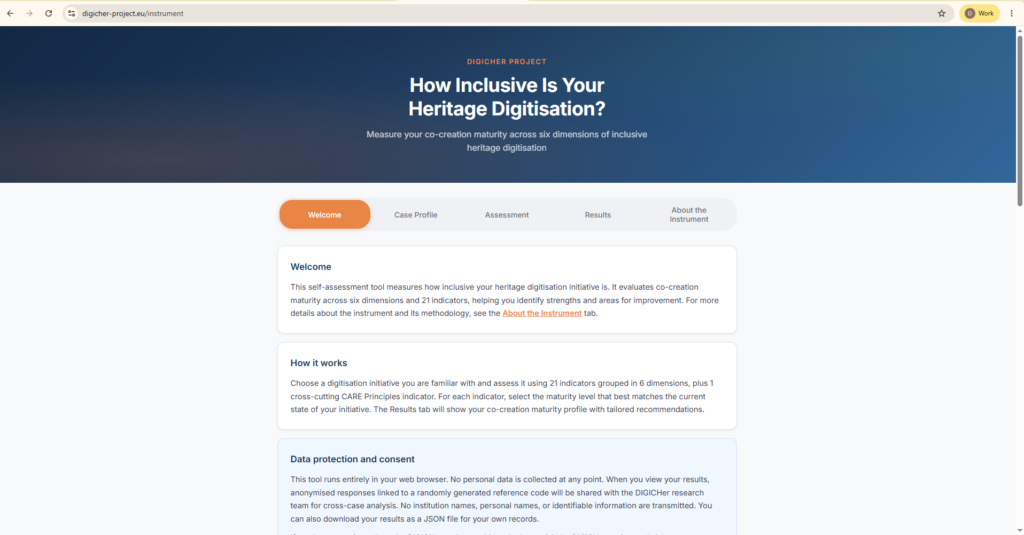
Figure 1: DIGICHer’s Co-creation Maturity Monitoring Instrument helps cultural heritage institutions assess how inclusive and community-centred their digitization practices are.
From sister-project exchange to joint policy work
The three sister projects opened a new coordination process to identify common lessons from their research, pilots and policy work and to translate them into shared messages for the European cultural heritage sector.
The projects agreed to work toward a joint position paper, drawing on policy recommendations and relevant project deliverables from all three consortia.
The collaboration is also being used to identify opportunities for:
- a joint online policy event based on the position paper
- coordinated responses to relevant European consultations
- cross-referencing recommendations and key project outputs
- mutual participation in final-period activities
- and continued cooperation after the individual projects reach the end of their funded periods
Each consortium is contributing its own policy recommendations and selected outputs to a shared working space. A second joint call is planned to review the first draft of the position paper and agree the next steps.
The planned online event is expected to take the form of a focused policy panel of approximately 90 minutes, using the joint paper as the basis for discussion.
A complementary policy perspective
The value of DIGICHer in this policy exchange is particularly strong around questions that are easy to overlook when discussing digital cultural heritage primarily in technological terms:
- Who decides what is digitized?
- Whose knowledge is used to describe an object?
- How should minority communities participate in decisions about access and reuse?
- How can digital representations avoid losing cultural context or authenticity?
- What governance structures are needed to ensure that digitization does not reproduce existing inequalities?
DIGICHer’s pilots and framework development with Sámi, Jewish and Ladin communities provide evidence directly related to these questions. Its work aims to produce recommendations for cultural heritage institutions and policymakers on equitable, participatory and sustainable digitization.
REEVALUATE brings a complementary perspective around prioritization, contextualization, rights-aware management and reuse.
Together, these perspectives strengthen the discussion from “how can we digitize and reuse cultural heritage?” to “how can we do it responsibly, inclusively and with the communities concerned?”