Press Release #4
- Home
- Synergies
- Press Release #4
PRESS RELEASE | October 2026
The REEVALUATE Project Brings Ancient Aquileia to Life Through Digital Heritage and Virtual Tourism
EU-funded project combines 3D digitization, archaeological expertise and public participation to create an interactive virtual experience of a Roman house in Aquileia, Italy.
Project developments covered: March–August 2026
How can visitors explore an ancient Roman house and discover the stories behind its archaeological treasures without being physically present? The EU-funded REEVALUATE project is demonstrating new possibilities through an interactive virtual tour of Titus Macer’s Domus in Aquileia, Italy.
Led by Fondazione Aquileia, with contributions from 3DR and Fondazione LINKS, the pilot brings together archaeological digitization, public participation and expert knowledge to make Roman heritage more accessible through digital technologies.
The virtual tour allows users to explore a reconstructed Roman residential complex, interact with selected archaeological objects and discover information about their historical significance.
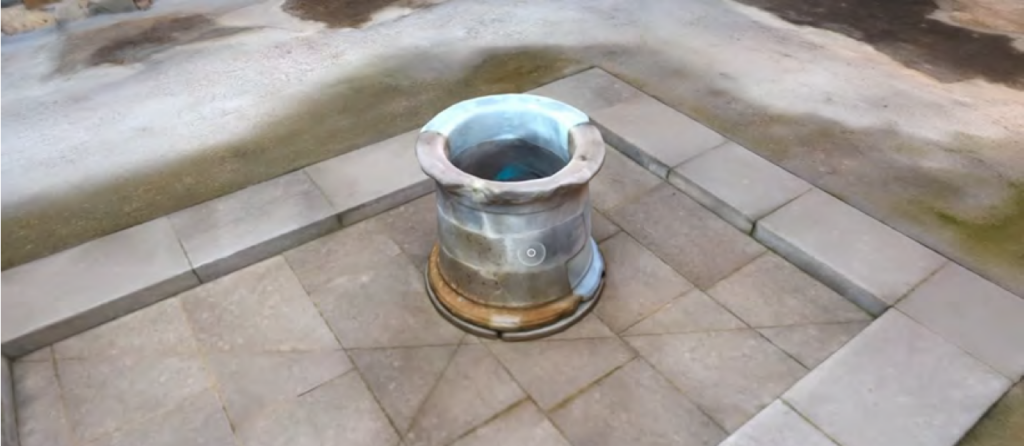
Figure 1:Screenshot from the REEVALUATE virtual tour showing a 3D reconstruction of a stone well at Titus Macer’s Domus in Aquileia.
Exploring Roman Aquileia through digital technology
Titus Macer’s Domus is an important Roman residential complex covering approximately 1,500 square meters, offering insights into everyday life, trade and domestic activities in ancient Aquileia.
Through the REEVALUATE pilot, 20 archaeological assets were digitized, including bronze statues, ceramic oil lamps, marble pieces, amphorae and coins. The Domus itself was also digitized, providing the foundation for the virtual reconstruction.
Developed by 3DR, the tour brings these digital materials together within an interactive environment.
Users can navigate reconstructed spaces, explore points of interest such as the oven, well and mosaic room, and interact with objects to access descriptions and contextual information.
The experience is accessible through a dedicated website without requiring additional software installation. It also supports immersive exploration through virtual reality equipment.
The application explores how virtual tourism can complement physical visits and support educational engagement with archaeological heritage.
Bringing public interest and expert knowledge together
A feature of the pilot is the involvement of both local audiences and archaeological specialists in shaping the digital experience.
Through REEVALUATE’s Public Sensing Prioritization Enabler, Fondazione Aquileia invited the public to engage with five artefacts associated with Titus Macer’s Domus: a stone weight, a wellhead, an oven, a sestertius and a polychrome mosaic.
The campaign helped identify which objects attracted the strongest interest, with the polychrome mosaic emerging as the most popular.
The project also organized a Human-Driven Contextualization Campaign, involving archaeologists and university professors who contributed historical interpretations and technical information about the selected objects.
The activity gathered 44 expert contributions, of which 42 were approved following curatorial review.
Together, these activities demonstrate how public preferences and specialist knowledge can contribute to more engaging and historically grounded digital heritage experiences.
New opportunities for archaeological heritage
A distinctive feature of the pilot is the involvement of both local audiences and archaeological specialists in shaping the digital experience.
Through REEVALUATE’s Public Sensing Prioritization Enabler, Fondazione Aquileia invited the public to engage with five artefacts associated with Titus Macer’s Domus: a stone weight, a wellhead, an oven, a sestertius and a polychrome mosaic.
The campaign helped identify which objects attracted the strongest interest, with the polychrome mosaic emerging as the most popular.
The project also organized a Human-Driven Contextualization Campaign, involving archaeologists and university professors who contributed historical interpretations and technical information about the selected objects.
The activity gathered 44 expert contributions, of which 42 were approved following curatorial review.
Together, these activities demonstrate how public preferences and specialist knowledge can contribute to more engaging and historically grounded digital heritage experiences.
About REEVALUATE
REEVALUATE is a Horizon Europe project developing a collaborative framework for the digitization, contextualization, management and responsible creative reuse of cultural heritage assets. The project brings together cultural heritage institutions, research organizations, technology providers and creative-sector stakeholders to develop and test innovative digital tools across three European pilots.
Project website: https://reevaluate.eu/
Project Coordinator
Dr. Anastasios Drosou (CERTH): drosou@iti.gr
Technical & Innovation Manager
Dr. Anastasia Dimou (KU Leuven): anastasia.dimou@kuleuven.be
Funded by the European Union under Grant Agreement No. 101132389.
Views and opinions expressed are however those of the author(s) only and do not necessarily reflect those of the European Union or the granting authority. Neither the European Union nor the granting authority can be held responsible for them.