Digital Heritage Is Not One-Size-Fits-All: Matching Digitization Methods to Objects and Uses
Digitizing cultural heritage is not simply a matter of choosing the most advanced scanner available.
A historic dress, a medal, a Roman house and a sound recording are fundamentally different types of heritage. Their materials, dimensions, condition and intended uses vary, and those differences should shape the way they are digitized.
Across REEVALUATE, one of the clearest lessons is that good digitization begins with matching the method to the heritage asset and to what the digital result is expected to do.
Our training material frames this around three practical questions:
What kind of object is it?
What condition is it in?
And what will the digital version be used for?
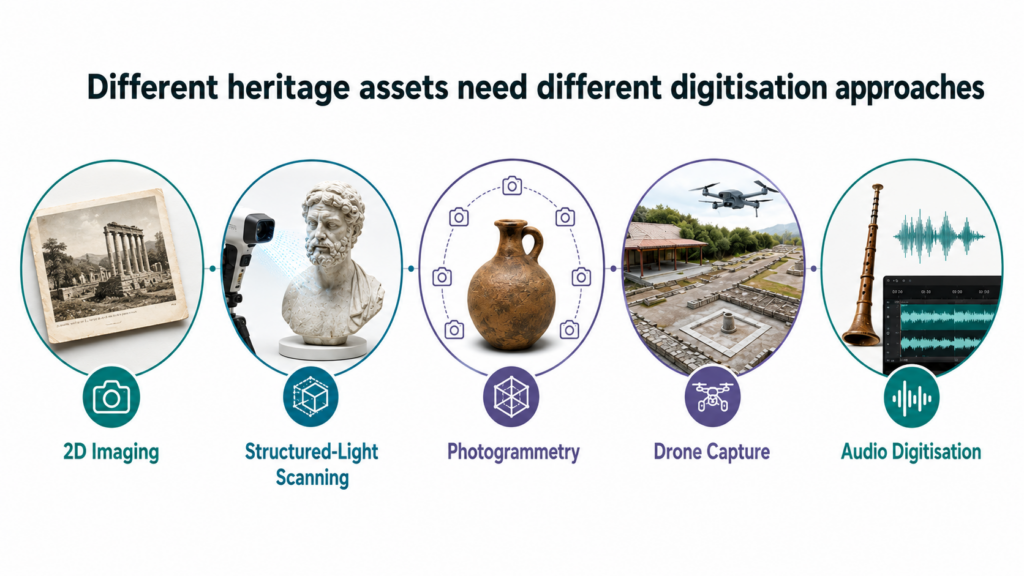
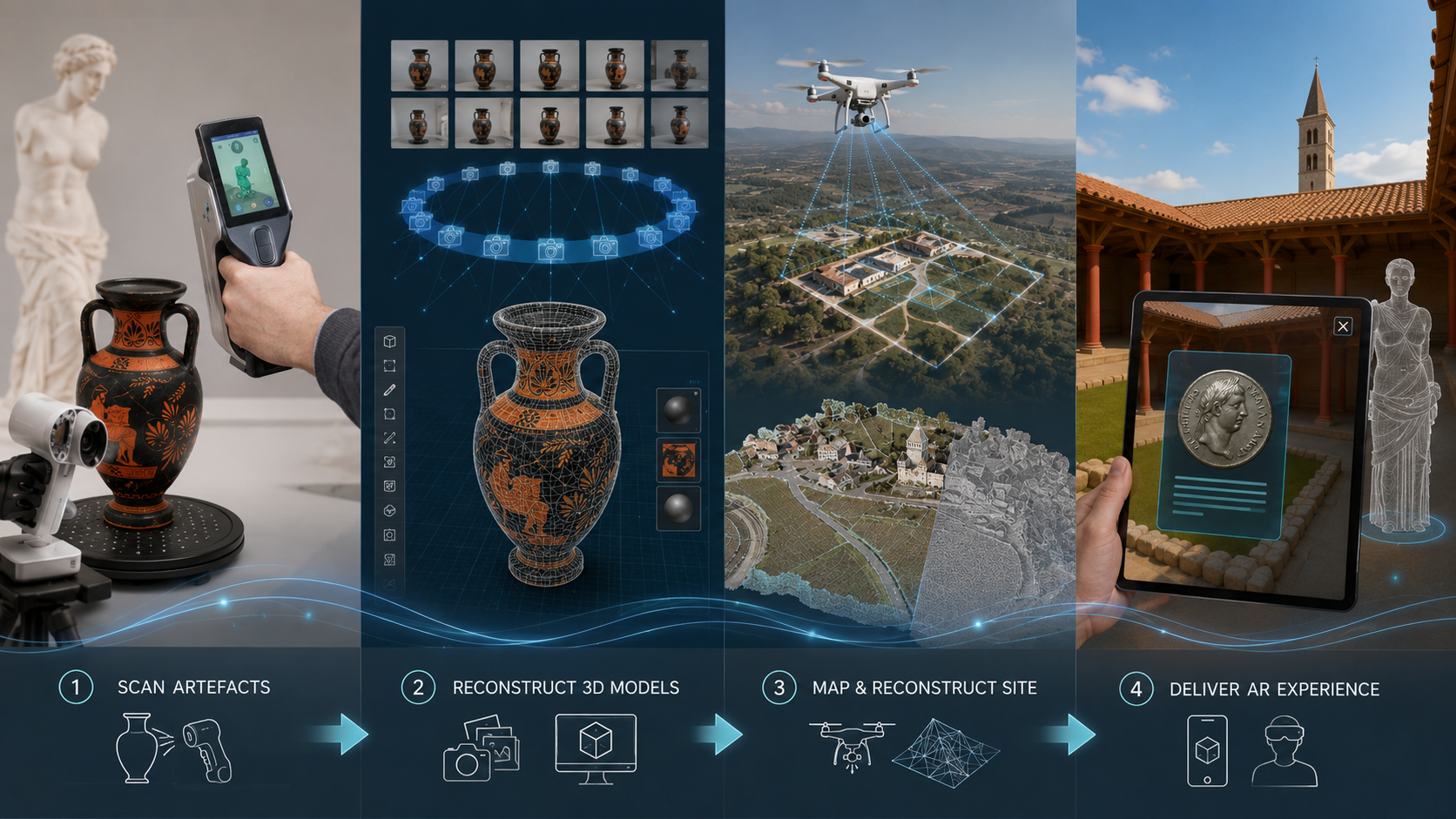
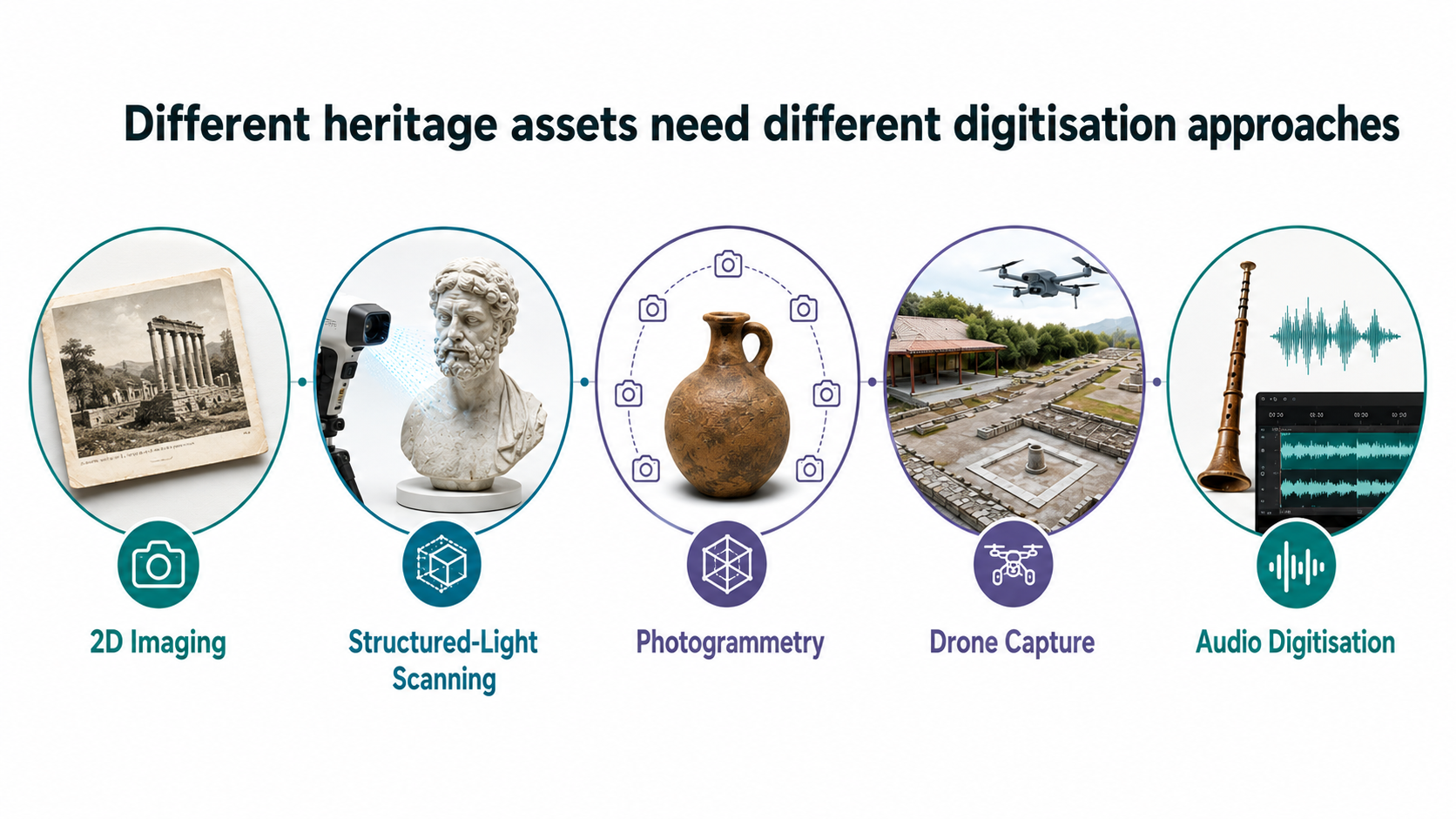
Figure 1: Across REEVALUATE, methods such as 2D imaging, structured-light scanning, photogrammetry, drone capture and audio digitization are selected according to the type of object and the intended use of the digital asset.
Start with the object, not the technology
It is tempting to begin digitization planning by asking what equipment is available.
A better starting point is the heritage asset itself.
A flat document or photograph may require precise two-dimensional imaging. A small three-dimensional object may benefit from structured-light scanning. Architecture and archaeological remains can require photogrammetry or aerial capture. Historical recordings require an entirely different audio workflow.
The physical characteristics of an object matter too.
Fragile textiles cannot necessarily be manipulated freely. Reflective surfaces can complicate 3D scanning or photography. Very small details may require a different capture strategy from large architectural structures.
This means that the same digitization method will not be equally appropriate for every collection.
Think about what the digital asset will be used for
The intended use can be just as important as the physical object.
A photograph intended mainly for an online catalogue has different requirements from a digital representation that will later be used in:
- a 3D virtual environment
- an immersive exhibition
- a sewing pattern
- research and documentation
- audiovisual production
- or creative reuse.
The REEVALUATE pilots illustrate this particularly well.
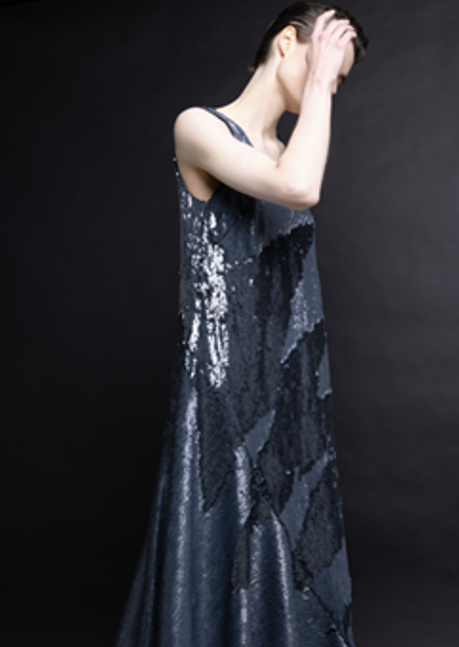
At MoMu in Antwerp, existing digitized material and detailed knowledge of garment construction supported the transformation of a historic evening dress into the contemporary Mildred sewing pattern.
At the Olympic Museum of Thessaloniki, different types of objects (including medals, cups, garments and documents) require different visual capture approaches.
At Aquileia, the scale changes completely, an entire archaeological site has to be documented alongside individual museum and site objects.
The result is not one standard pipeline applied repeatedly. It is a set of choices based on what each asset is and what the digital representation needs to support.
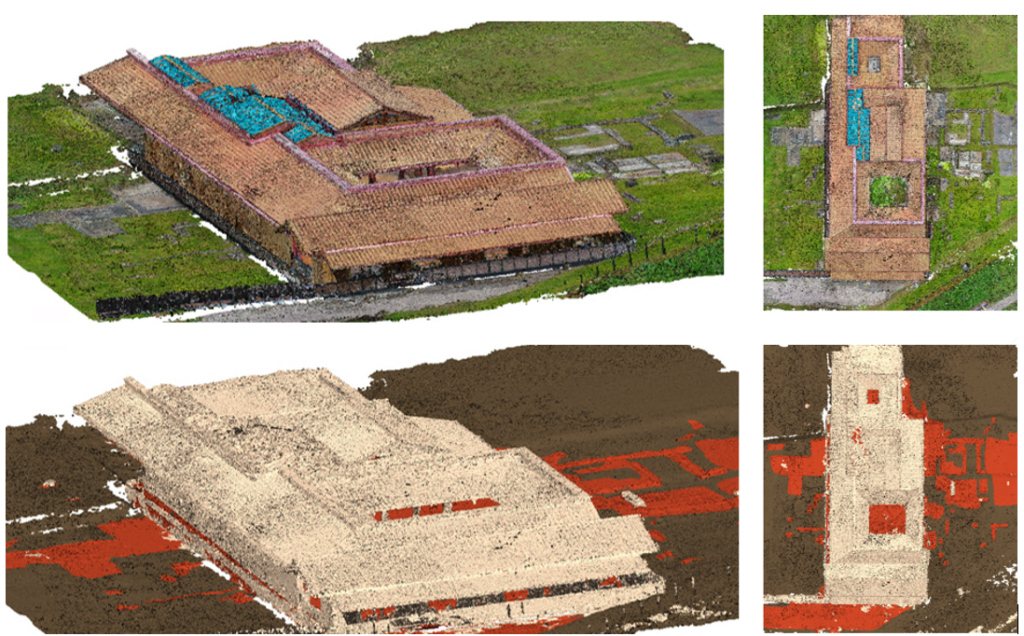
Figure 2: Point-cloud reconstruction of the Domus of Titus Macer in Aquileia, showing how photogrammetry can be used to document a large archaeological site in detailed 3D form.
Sometimes methods need to be combined
Choosing the right technique does not always mean choosing only one technique.
Aquileia provides a good example.
For the Domus of Titus Macer, REEVALUATE combines aerial photographs captured by drone with manual camera photography. The additional photographs help cover details and areas that cannot be adequately captured from above. The datasets can then be combined into a detailed textured 3D representation.
Individual archaeological objects are treated differently.
Pilot 3 utilized a combination of structured-light scanning and photogrammetry, with structured-light scanning suited to medium-sized objects requiring precise geometry, while photogrammetry can support particularly small or highly detailed material.
The lesson is simple:
digitization methods are tools to combine where useful, not competing technologies from which institutions must choose a single winner.
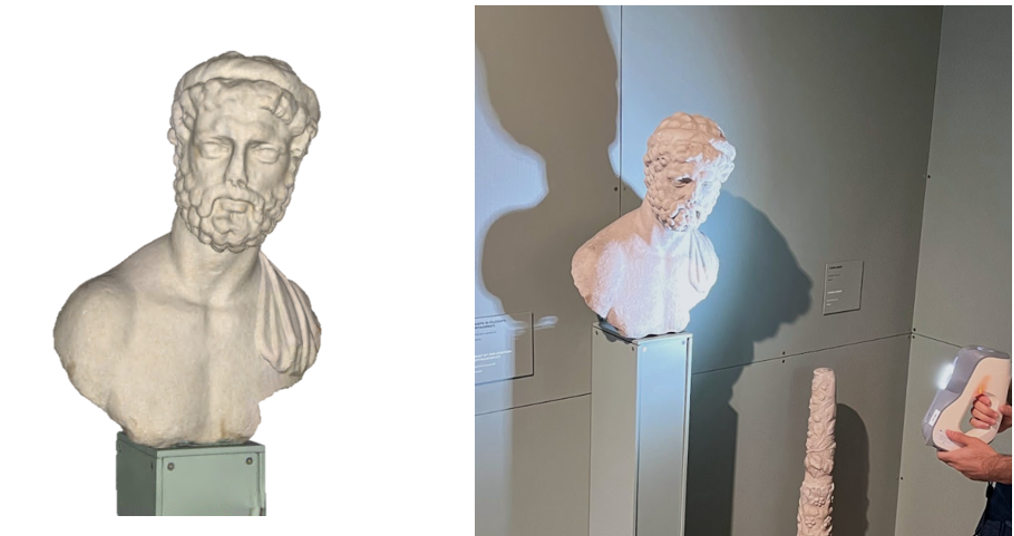
Figure 3: Example of an archaeological object in Aquileia being captured through 3D scanning, illustrating how detailed geometry can be recorded for smaller cultural heritage assets.
Sometimes the smartest decision is not to digitize again
Another important part of planning is checking what already exists.
Digitization should not automatically mean producing a new scan or photograph.
Existing digital assets may already be suitable if they have sufficient quality, usable metadata and appropriate rights information.
This is relevant to collections that have been digitizing material for many years.
REEVALUATE’s work with MoMu illustrates this point: much of the fashion collection already existed in digital form, meaning the project could focus on how existing material could be enriched, interpreted and reused.
Avoiding unnecessary recapture saves time and resources and allows institutions to focus investment where new digitization can provide genuine additional value.
Quality should follow purpose
More resolution is not automatically better.
A technically impressive capture can still be unsuitable if it is not produced with its eventual use in mind.
For long-term value, institutions also need to consider:
- appropriate master files
- lighter access versions where needed
- colour and scale accuracy
- documentation of the capture process
- metadata created alongside the digital asset
- and formats suitable for future use
The point is not to maximize every technical parameter.
It is to create a digital representation that is fit for purpose and capable of remaining useful over time.
From “How do we digitize it?” to “Why are we digitizing it?”
The most useful digitization question is therefore not:
“Which technology should we use?”
It is:
“What do we want this digital asset to enable?”
Once that is clear, decisions about technique, quality, scale and resources become much easier to justify.
A Roman site intended for virtual exploration needs something different from a garment being studied for pattern reconstruction.
A museum catalogue photograph has different requirements from a three-dimensional object intended for immersive reuse.
A historic sound recording cannot be approached in the same way as either.
REEVALUATE’s pilots demonstrate that digitization works best when technology follows the heritage, not the other way around.
Different objects need different approaches, and different uses require different digital results.
That is why cultural heritage digitization is never truly one-size-fits-all.
REEVALUATE has received funding from the European Union’s Horizon Europe Research and Innovation Programme under Grant Agreement No. 101132389.