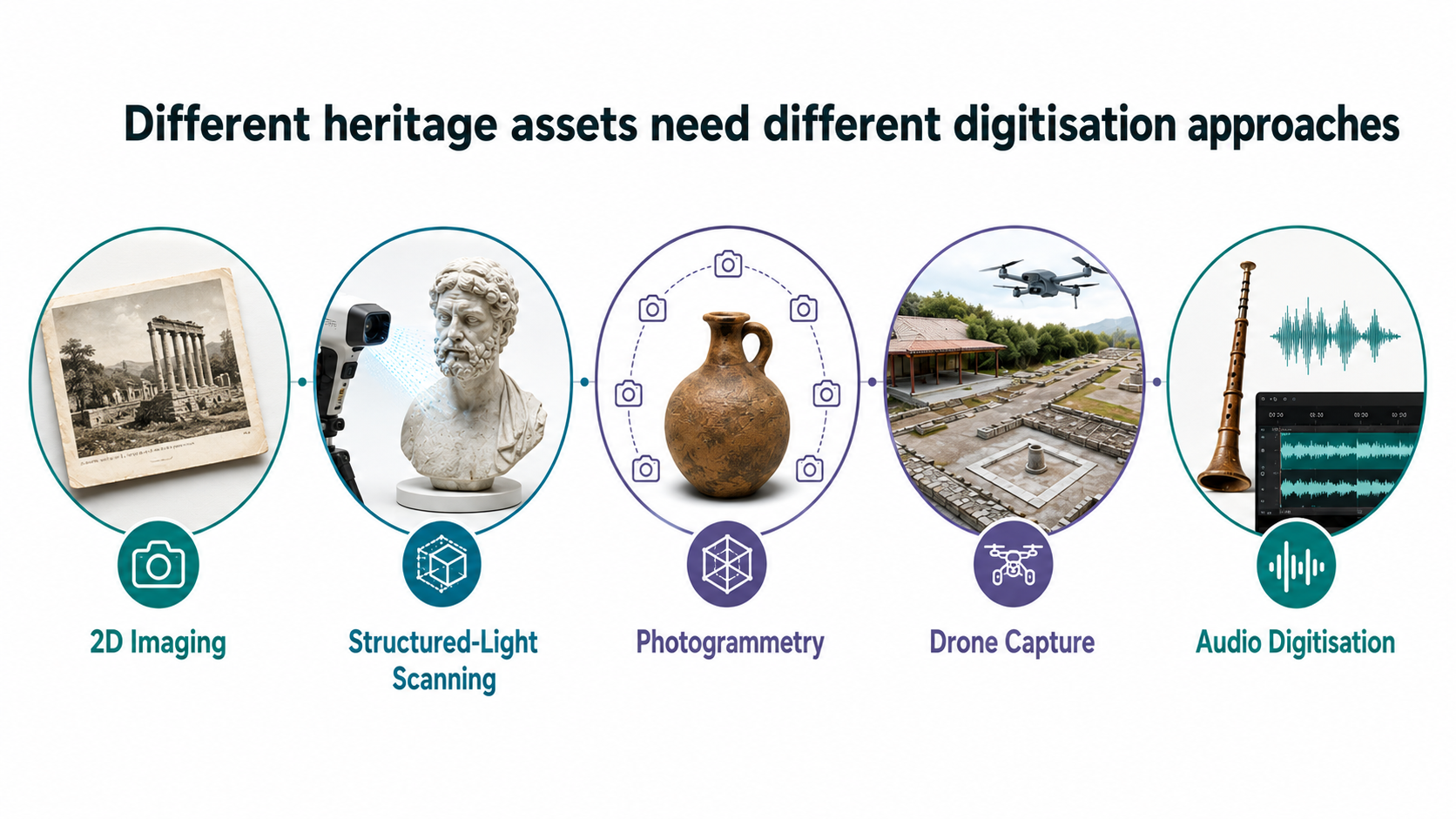
From Individual Tools to One Workflow: How the REEVALUATE Platform Fits Together
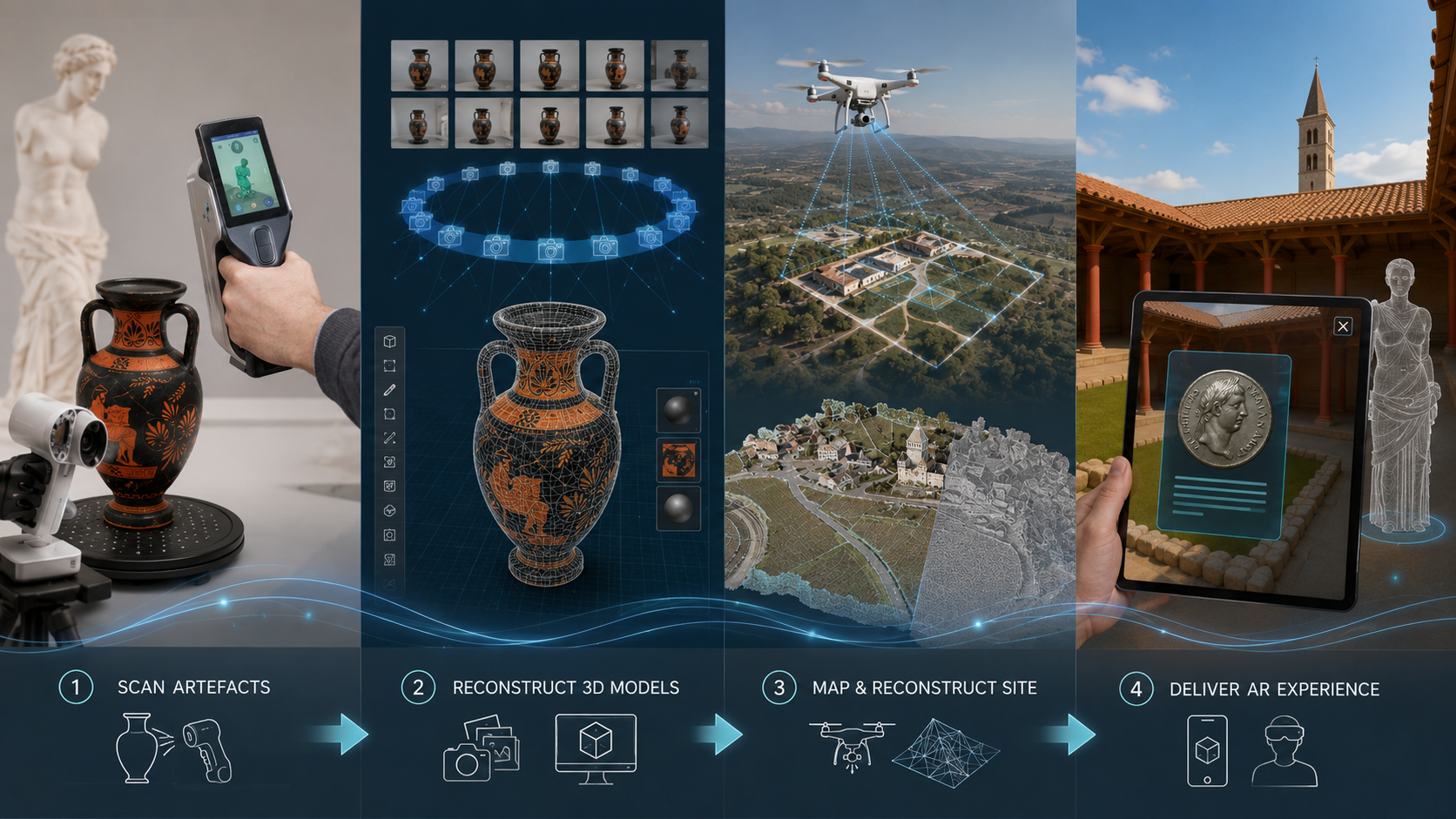
Digitizing a cultural heritage object is rarely a single action.
Before an object becomes a useful digital asset, an institution may need to decide what to digitize, create or collect its digital representation, enrich it with reliable context, manage rights and provenance, make it discoverable, connect it with potential users, and eventually ensure that its reuse respects the conditions attached to it.
REEVALUATE has developed specialized technological enablers for these different stages. But the aim has never been simply to create a collection of separate tools.
The Integrated REEVALUATE Platform connects them into a common environment, allowing cultural heritage professionals and creative users to move across different stages of the digital heritage lifecycle through connected workflows.
The project’s second integrated platform release builds on the first technical integration and incorporates lessons from pilot deployment, testing and stakeholder feedback.
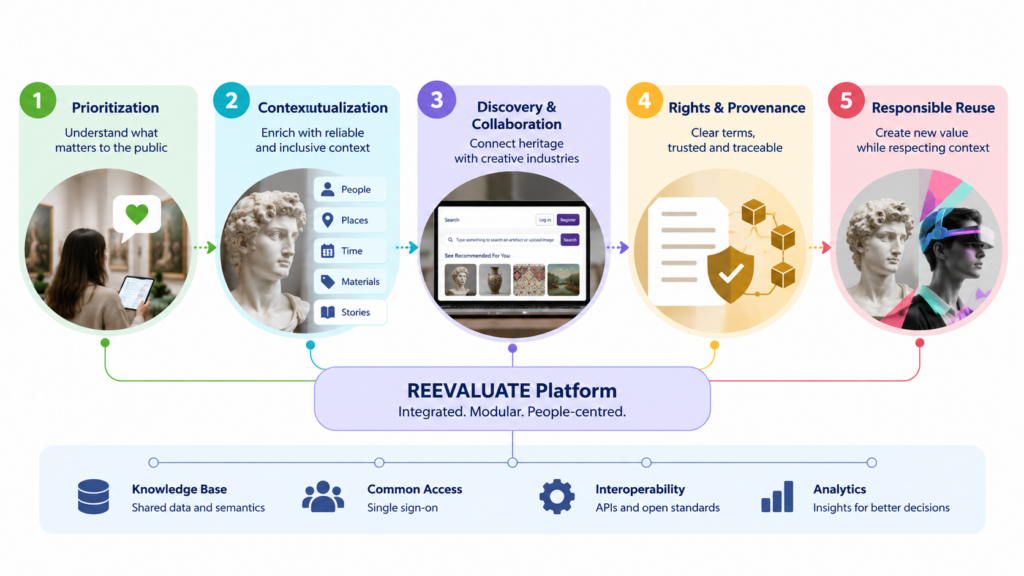
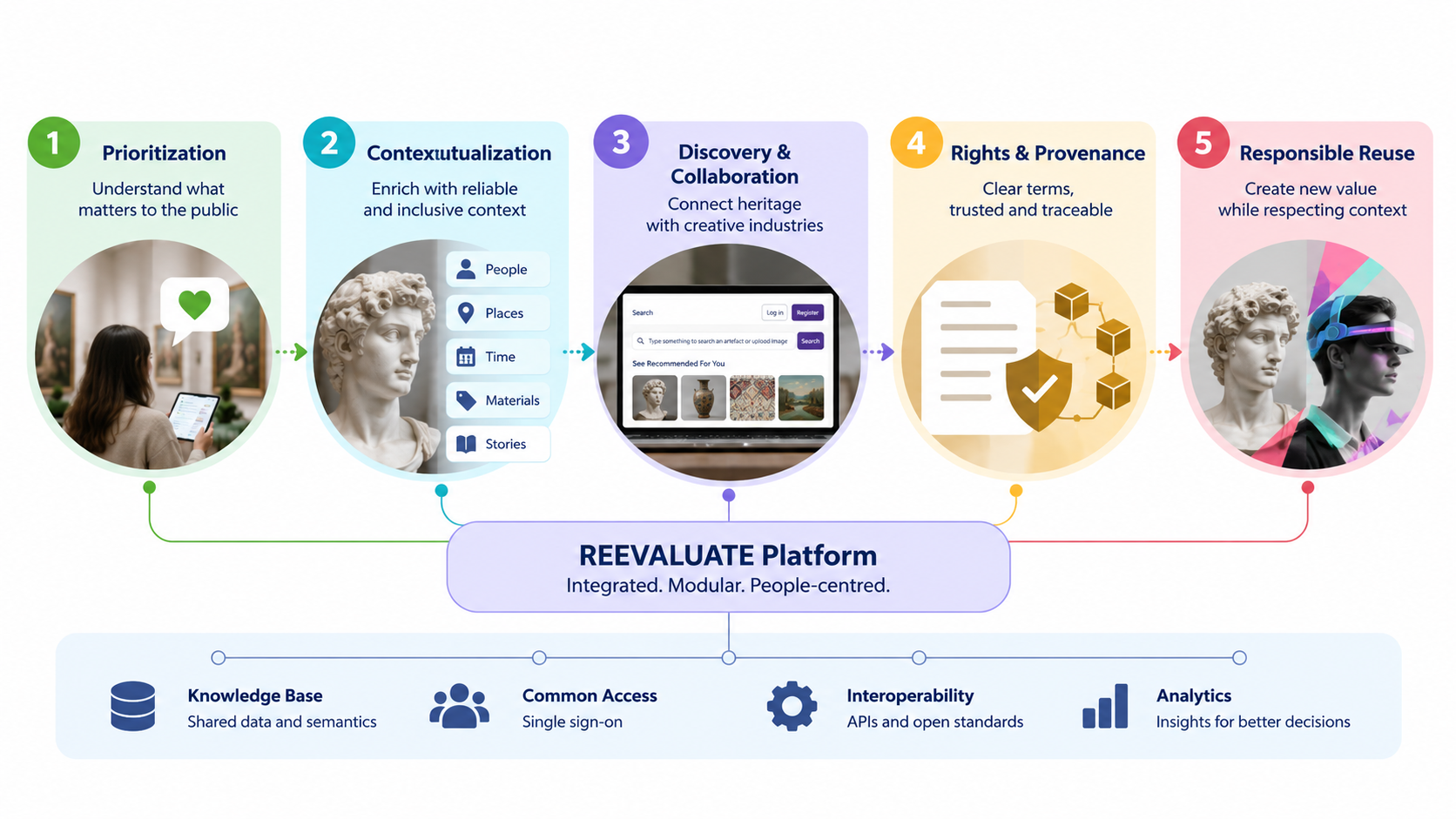
REEVALUATE connects prioritization, contextualization, discovery, rights management and responsible reuse within a common platform environment.
From technical integration to user workflows
The first platform release established the technical foundations needed for the different REEVALUATE applications and enablers to communicate and operate together.
But testing showed that technical interoperability alone was not enough.
From a user’s perspective, the important question is not whether two services can exchange data. It is whether the person working with a cultural heritage asset can understand where to begin, what happens next, and how one task connects to another.
This became one of the central lessons of the first iteration. Cultural heritage users experience the REEVALUATE framework through workflows, not technical components. The second platform release therefore focused not only on improving individual enablers, but on strengthening the connections between them.
The updated platform supports four major end-to-end workflows:
- prioritizing physical artifacts for digitization;
- uploading a digital artifact and enriching its contextual metadata;
- discovering digital artifacts and establishing reuse agreements;
- validating whether the resulting production respects the agreed conditions.
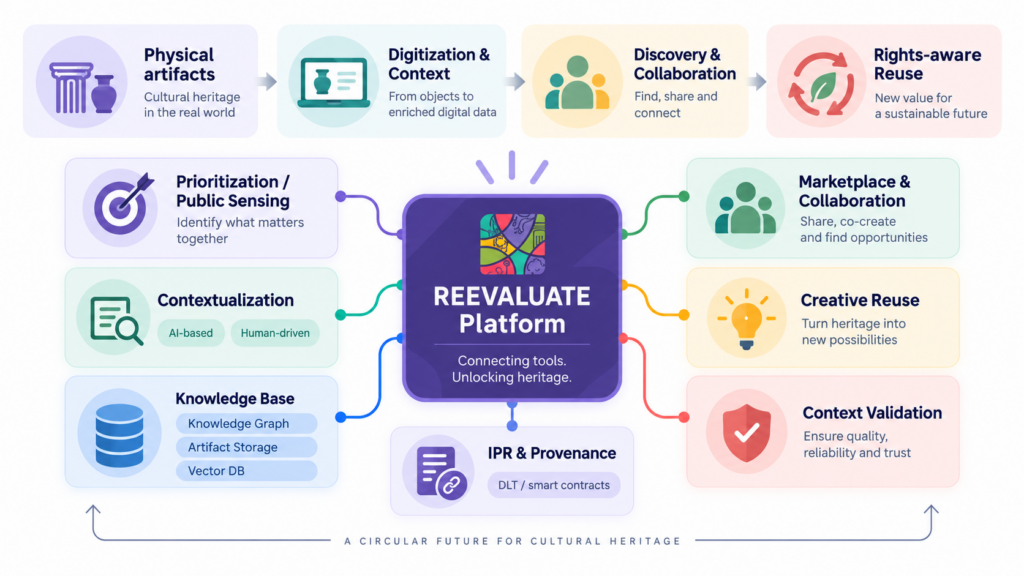
The updated REEVALUATE Platform connects specialized enablers around shared workflows for artifact management, discovery, reuse and validation. Adapted from D4.10 – Integrated REEVALUATE Platform.R2.
1. Prioritizing what should be digitized
The workflow can begin before a digital artifact even exists.
Cultural heritage institutions often manage collections that are far larger than available digitization resources. Decisions therefore have to be made about which objects should be digitized first.
The Public Sensing Prioritization Enabler adds one source of evidence to that decision-making process by allowing institutions to gather public-interest signals around physical artifacts.
Its role is not to replace curatorial judgment. Instead, it complements institutional expertise with information about what audiences are responding to.
This makes prioritization the first part of a broader lifecycle: public participation can inform what should enter the digitization process before resources are committed to creating and managing a new digital asset.
2. Uploading and enriching a digital artifact
Once an artifact has been digitized, it can enter the platform’s common data environment.
The REEVALUATE Knowledge Base combines several complementary forms of information. Structured and contextual metadata are represented through the Knowledge Graph, digital files are managed through artifact storage, and vector representations can support AI-based similarity search and retrieval. Together, these services allow different enablers to work with the same cultural heritage asset rather than maintaining disconnected copies and descriptions.
Contextualization then adds meaning to the digital representation.
REEVALUATE combines human-driven and AI-supported contextualization. Human contributors can suggest, review and refine contextual information, while AI services can support the analysis of visual, textual and aural material.
One important change in the second platform release is the more direct connection between the Marketplace and contextualization enablers. This was introduced so that users can retain the perspective of the digital artifact they are working on and have a clearer single entry point for new artifacts, reducing confusion about where information should enter the platform.
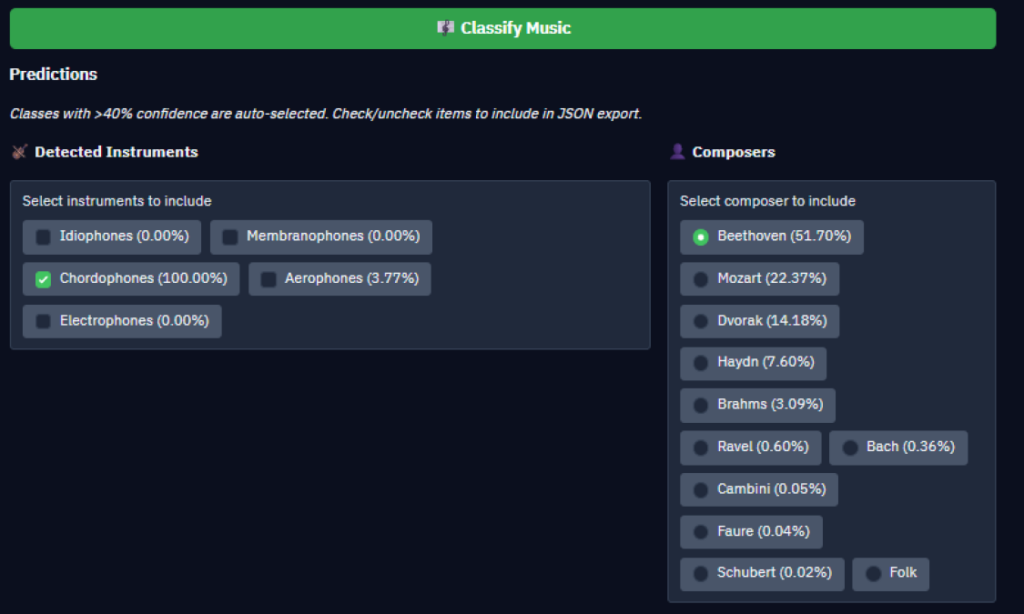
Example of AI-supported aural contextualization: the interface presents detected instrument categories together with confidence values and suggested composer information. Source: REEVALUATE D4.10 – Integrated REEVALUATE Platform.R2.
The aural contextualization example shown above illustrates how AI results are presented as information that can be inspected and selected by the user rather than simply inserted invisibly into the platform.
The same principle applies to human contributions.
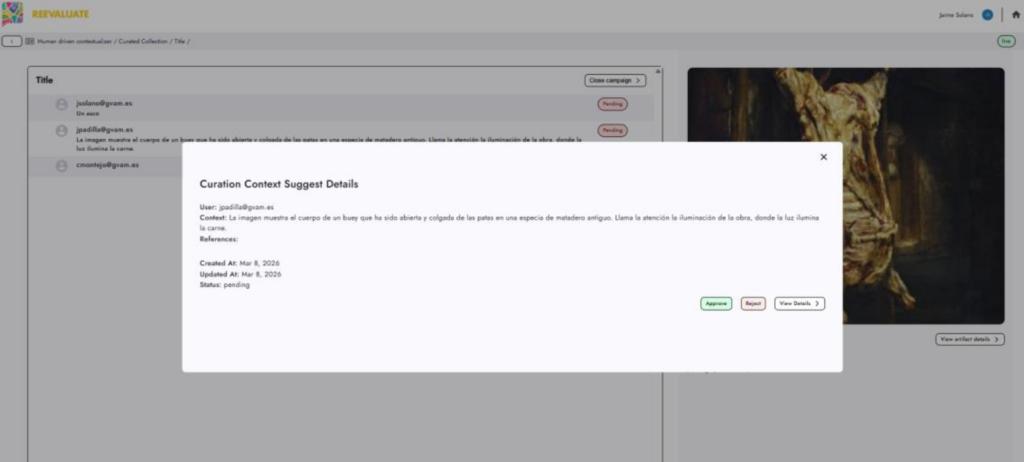
Human-driven contextualization allows a suggested contribution to be reviewed, approved or rejected before it becomes part of the wider context associated with a digital artifact. Source: REEVALUATE D4.10 – Integrated REEVALUATE Platform.R2.
This combination is important because cultural heritage context is rarely reducible to a single automated answer. The platform is designed to allow machine-supported enrichment while retaining opportunities for human review, correction and additional interpretation.
3. From discovery to collaboration and reuse
Once digital artifacts have been enriched and made available, the next challenge is helping potential users find relevant material.
The Collaboration Enabler supports retrieval and recommendation functions, while the Marketplace provides the environment through which digital cultural heritage assets can be explored and connected with potential reusers.
The quality of this discovery process depends on the rest of the platform. Richer contextual metadata, structured semantic relationships and better artifact information all contribute to making search and matchmaking more useful.
Search is not treated as an isolated function sitting on top of a database. It is connected to the contextual information accumulated earlier in the workflow and can become the starting point for a later reuse relationship.
A user can move from finding an artifact, to understanding its context, to exploring how it may be reused.
4. Connecting reuse with rights and validation
Reuse does not end once access to an artifact has been granted.
Cultural heritage institutions also need mechanisms for keeping provenance, permissions and agreed conditions connected to the digital asset throughout the reuse process.
REEVALUATE addresses this through the DLT-based IPR Management Enabler, which supports provenance and rights-management functions, and the Context Validation Enabler, which can be used to assess whether reused or newly generated content respects relevant conditions.
In the second platform release, the Context Validation Enabler was more closely integrated with Marketplace infrastructures and reuse workflows. Validation can be linked to an existing digital artifact and a relevant smart contract, connecting the content being checked with the reuse relationship under which it was produced.
This creates a much clearer sequence:
- Artifact
- Rights and conditions
- Reuse
- Validation
The updated Context Validation Enabler also responds to pilot feedback by improving the clarity of outputs, detection reliability, explanations and user guidance, while strengthening its connection with creative reuse workflows.
Specialized tools, shared foundations
Connecting these workflows does not mean combining every function into one giant application.
REEVALUATE uses a modular, microservice-based architecture. Individual enablers remain specialized and can evolve independently, while common services allow them to work together.
These shared foundations include:
- the Knowledge Base, linking structured data, artifact files and vector representations;
- common authentication and access services;
- the Marketplace and Hub as major user access points;
- and APIs that allow information to move between the relevant components.
This architecture allows specialization and integration to coexist.
A contextualization tool can remain focused on metadata enrichment. A validation tool can remain focused on checking content. A rights-management component can remain focused on provenance and agreements.
Their broader value emerges when the result of one stage becomes meaningful input for the next.
From a collection of capabilities to an integrated platform
The evolution from the first to the second REEVALUATE platform release is therefore not only a story about adding new functionality.
It is a story about making the existing functionality work together more coherently.
Pilot implementation and stakeholder feedback helped identify where users encountered unclear navigation, insufficient connections between tools, or workflows that worked technically but were not yet intuitive enough in practice. Those lessons informed the second release, including a stronger focus on the Marketplace as a central point for artifact management and reuse-related workflows.
This reflects a broader lesson for digital cultural heritage infrastructures.
Interoperability matters at two levels:
systems need to exchange information, and users need to be able to follow the process.
REEVALUATE’s second integrated release brings those two dimensions closer together.
One ecosystem across the digital heritage lifecycle
The challenges surrounding cultural heritage digitization do not stop when a digital file has been produced.
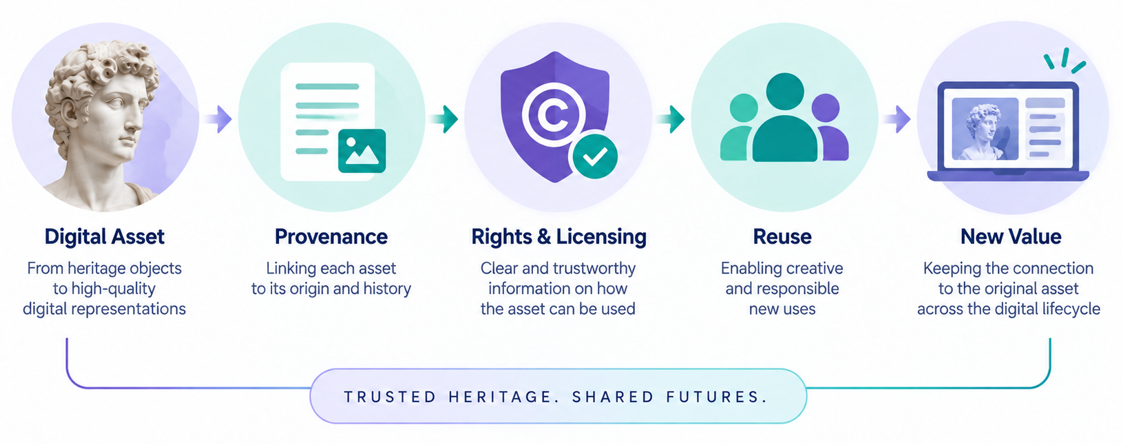
Selection, context, discoverability, provenance, rights, collaboration and responsible reuse continue throughout the asset’s digital lifecycle.
The Integrated REEVALUATE Platform brings technological responses to those challenges into a connected environment.
Public participation can inform what is digitized. Human and AI tools can enrich its context. Structured information can support discovery. The Marketplace can connect cultural heritage institutions with prospective reusers. Rights-management services can support traceability and agreements, while validation can help assess whether resulting uses respect the relevant conditions.
The individual enablers remain modular.
What turns them into a platform is the workflow between them.
That is the direction represented by the second Integrated REEVALUATE Platform release. Moving from a set of technological capabilities toward a connected environment supporting cultural heritage from digitization to responsible reuse.
REEVALUATE has received funding from the European Union’s Horizon Europe Research and Innovation Programme under Grant Agreement No. 101132389.