REEVALUATE, DIGICHer and IMPULSE publish joint position paper on digital cultural heritage
When a museum or archive puts a collection online, it makes decisions that shape how people will use it for years. Which items should be digitised first? Who should help describe them? And when those items are shared on another platform, will people still know where they came from and what they can do with them?
REEVALUATE, DIGICHer and IMPULSE explore these questions in their joint position paper, Who decides and who benefits: Digitised cultural heritage in the age of AI, data spaces and virtual worlds. Drawing on evidence collected by the three Horizon Europe projects since 2024, the paper sets out 13 recommendations for heritage institutions, funders and policymakers. Read the joint position paper on Zenodo.
Four priorities for digitisation and reuse
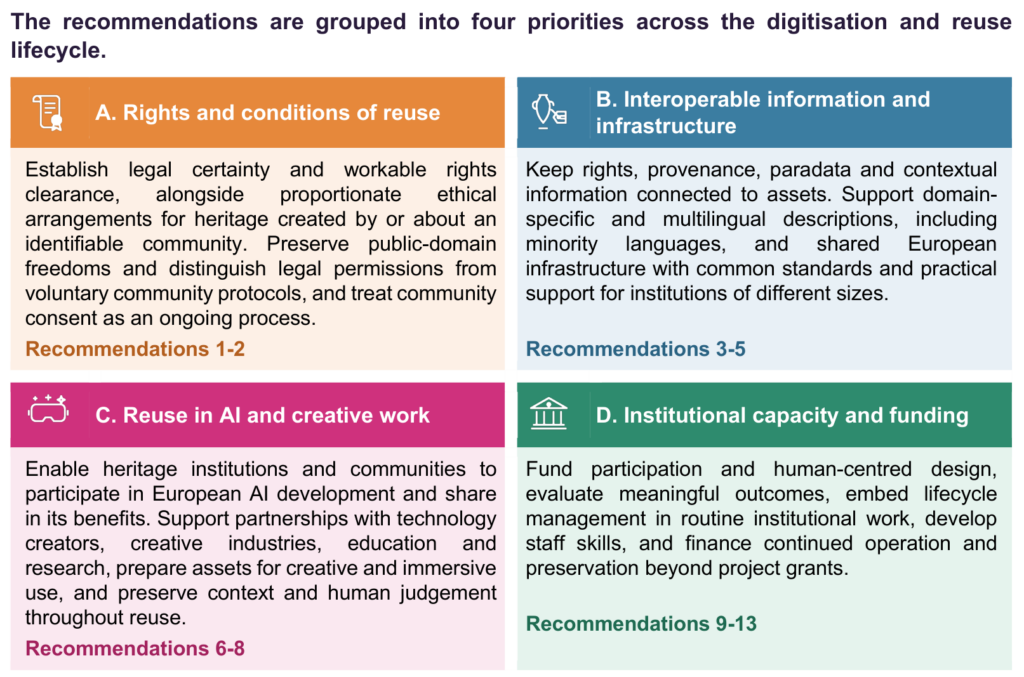
The four priorities and their corresponding recommendation numbers. Cropped from the executive summary of the joint position paper, p. 2. © 2026 DIGICHer, REEVALUATE and IMPULSE consortia. CC BY 4.0.
What should travel with a digital object?
Imagine an educator finding a digitised object for a lesson. To use it well, they need to know where it comes from, how to credit it and what permissions apply. A researcher working with the same object might also need to know how it was captured or what changed during digitisation. The paper recommends keeping that information with the object as it moves between platforms. It also calls for descriptions in regional and minority languages and for communities to have a say in how their heritage is reused.
For REEVALUATE, this connects decisions made early in the project’s workflows, such as what to digitise and how to document it, with what people can later discover and create. Reuse can also add knowledge back to the collection. An exhibition, research project or creative partnership can generate new descriptions and interpretations worth preserving alongside the original record.
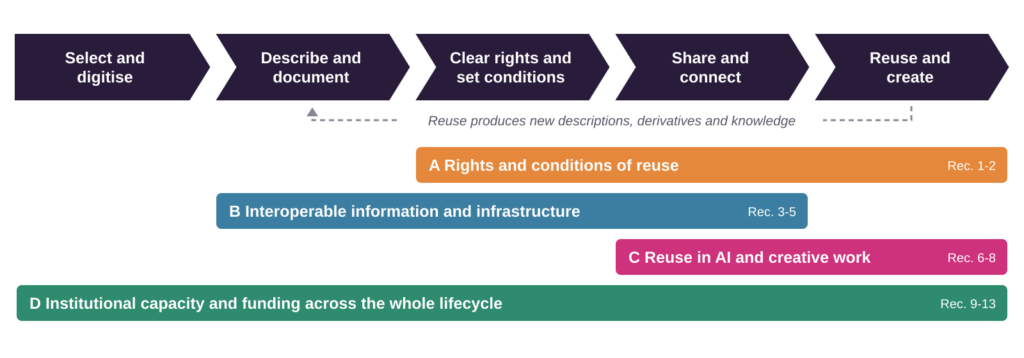
How the four priorities apply across the collection lifecycle. Figure 1 from the joint position paper, p. 4. © 2026 DIGICHer, REEVALUATE and IMPULSE consortia. CC BY 4.0.
Who keeps collections accessible after a project ends?
Digital collections need people to update descriptions, maintain services and work with the communities whose heritage they represent. The paper asks funders and institutions to account for this work and to plan for continued operation and preservation beyond the original project grant. Explore all 13 recommendations on Zenodo.
The three projects will discuss the paper at a free online webinar hosted by the Europeana Foundation on Friday, 27 November 2026, from 10:00 to 11:30 CET. Webinar details and registration.
REEVALUATE has received funding from the European Union’s Horizon Europe Research and Innovation Programme under Grant Agreement No. 101132389.