Public Sensing and Cultural Heritage: Exploring Audience Engagement in REEVALUATE
Cultural heritage institutions make choices all the time about which objects, stories and collections receive attention.
Those choices are rarely based on a single factor. Curatorial expertise, conservation needs, research priorities, available resources, partnerships and exhibition opportunities can all influence which assets are selected for digitisation or further development.
REEVALUATE explores whether public-interest signals can provide one additional perspective within this process.
This is the role of the Public Sensing Prioritization Enabler: a web-based tool that allows cultural heritage institutions to create campaigns around selected artefacts, engage audiences through social media and analyse the interaction that follows. The project originally conceived the enabler as a way of supporting participatory prioritisation through social sensing, campaigns, gamification and analysis of reactions and comments.
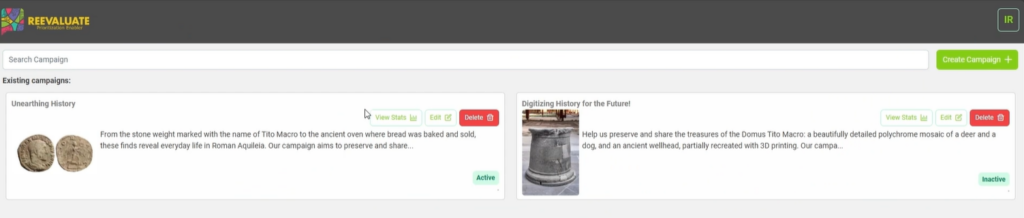
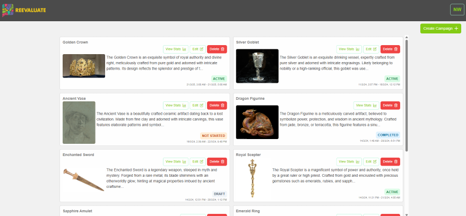
Figure 1: The REEVALUATE Public Sensing Prioritization Enabler allows cultural heritage institutions to create and manage engagement campaigns around selected artefacts.
From institutional priorities to audience signals
Museums and heritage organizations already have established ways of deciding what to work with.
Sometimes a conservation requirement determines the priority. In other cases, an exhibition, research question or collaboration opportunity may already define which part of a collection receives attention.
Professional expertise therefore remains central.
The Public Sensing Prioritization Enabler adds something different: institutions can take a pre-selected group of cultural heritage assets and explore how audiences respond to them.
The resulting information does not provide a definitive answer to the question “What should we digitize?” Instead, it can help answer a narrower and often useful question:
Which of these assets attract attention and engagement from the audiences we are trying to reach?
REEVALUATE’s integrated platform describes the enabler as analyzing engagement signals such as likes, comments and reactions to help institutions identify artefacts generating higher societal interest.
How does a campaign work?
The process begins with the cultural heritage institution.
A curator or authorised user creates a campaign and selects the artefacts to be presented. The campaign is then published through social media, where audiences can encounter the objects and respond to them.
This creates a straightforward flow:
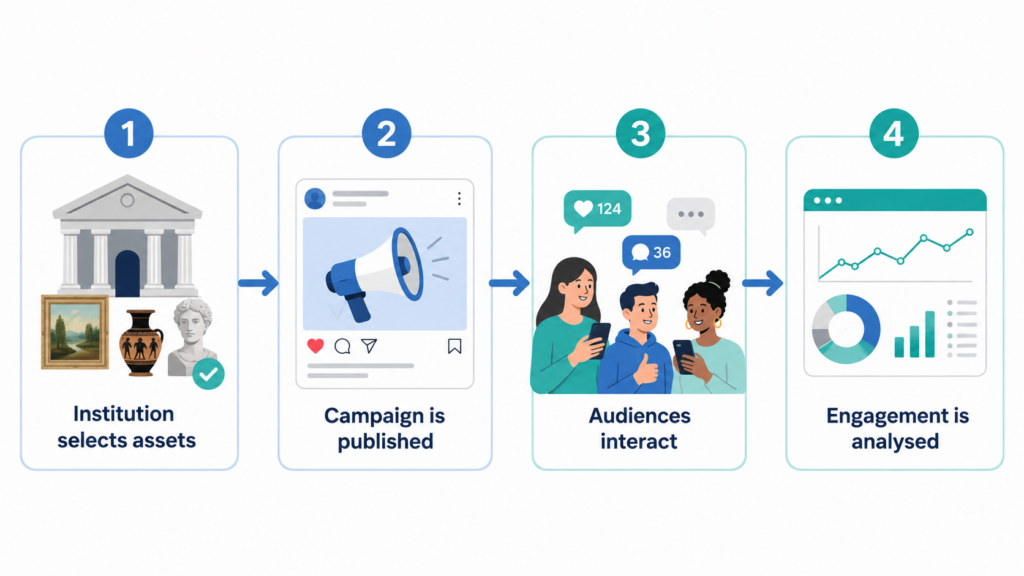
In this way, the public-facing part of the enabler takes place where many audiences already encounter cultural content: on social media.
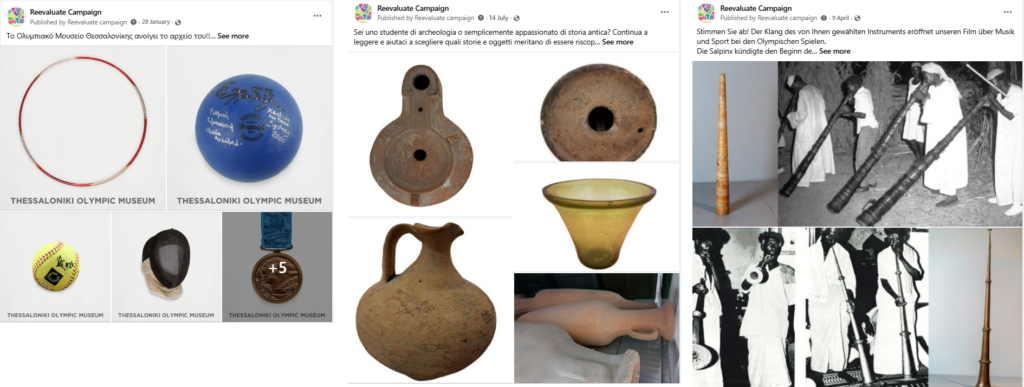
Figure 2: Example of a public-facing REEVALUATE campaign featuring artefacts from the three REEVALUATE pilots. Social-media posts provide the point of interaction between the campaign and its audience.
Looking beyond the number of votes
A campaign can provide more than a simple ranking.
The enabler can bring together information about votes, comments and other forms of interaction. Its statistics functionality also includes sentiment and emotion analysis, helping institutions examine not only how much engagement an artefact receives, but also the character of the responses around it.
A highly popular artefact is not necessarily more historically important than another, and the object receiving the most reactions does not automatically become an institution’s highest priority.
Instead, these results can provide audience insight.
They can help cultural heritage professionals identify which objects prompt interaction, which generate discussion and whether different artefacts produce different types of response.
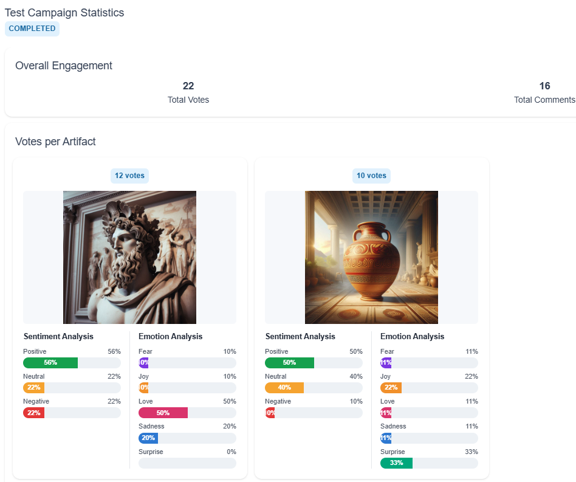
Figure 3: Example statistics from the Public Sensing Prioritization Enabler, combining voting results with sentiment and emotion analysis.
Engagement can be valuable in its own right
Testing the enabler through the REEVALUATE pilots is also helping clarify where this type of tool can provide the most value.
In Pilot 2, involving the Olympic Museum of Thessaloniki and the Ethnologisches Museum in Berlin, the Public Sensing Prioritization Enabler is described as supporting interactive campaigns intended both to engage audiences and to explore which cultural heritage assets are particularly recognizable or interesting to the public. The same pilot also considers social media as a way of involving audiences in the development of the exhibition experience.
The Aquileia pilot similarly uses public sensing as part of a broader participatory approach, involving younger members of the local community in engagement around selected archaeological assets. At the same time, professional stakeholders such as archaeologists, historians and scholars contribute different forms of expertise through the project’s contextualisation activities.
This highlights an important distinction:
public interest and professional expertise are different forms of information.
They do not have to compete.
Curatorial knowledge, conservation priorities, institutional strategies and practical opportunities may remain the strongest factors in deciding what an institution ultimately works with. Public sensing can complement those considerations by showing how audiences respond to selected material.
In some situations, that information may contribute to prioritization. In others, its strongest value may be in engagement, communication and understanding audiences.
What REEVALUATE is learning
Public participation does not need to mean handing cultural heritage decisions over to popularity.
A more realistic role is to create structured opportunities for institutions to present selected heritage material, invite interaction and examine what happens next.
The Public Sensing Prioritization Enabler provides one way of doing this.
It allows institutions to move from simply publishing cultural content towards asking audiences to respond to it, while giving cultural heritage professionals additional information they can consider alongside their own expertise and institutional needs.
The resulting value may differ from one institution to another.
For some, audience signals may help distinguish among potential priorities. For others, the greater benefit may be that a campaign creates a new point of contact between the collection and the communities around it.
Both outcomes are relevant to REEVALUATE’s wider objective of exploring more participatory approaches to cultural heritage.
Public interest does not replace expert judgement. But it can become another useful signal and engagement itself can be a meaningful result.
REEVALUATE has received funding from the European Union’s Horizon Europe Research and Innovation Programme under Grant Agreement No. 101132389.